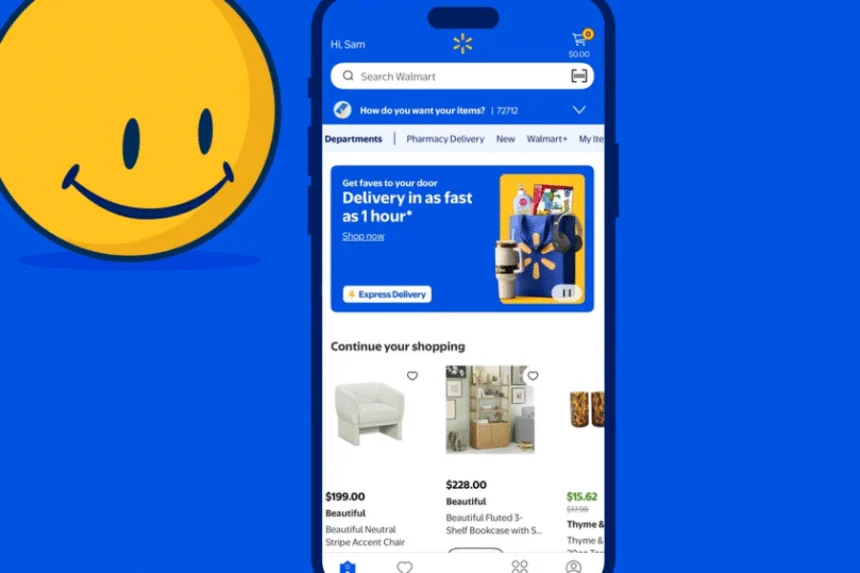
The Death of the Search Bar: Walmart’s "Sparky" and the $5B Race to Monetize Chat
The search bar is dying, and Walmart is ready to monetize its successor. With the introduction of "Sponsored Prompts" inside its Sparky AI assistant, the retail giant is transforming helpful customer chats into a high-stakes bidding war. Here is how this move challenges Amazon's dominance and risks breaking consumer trust in the age of agentic commerce.
Imagine you are planning a unicorn-themed birthday party. In 2024, you typed "unicorn party supplies" into a search bar and scrolled through grids of napkins and plastic horns. Today, you open the Walmart app and tell Sparky, the retailer's AI assistant: "I need a unicorn party for ten six-year-olds, under $100, delivered by Saturday."
Sparky doesn't just list products; it builds a cart. But starting this week, that conversation has a new participant: the highest bidder.
Walmart has officially rolled out Sponsored Prompts within Sparky, transforming its helpful shopping concierge into a high-stakes advertising battleground. This move, detailed in a recent report by B&T, signals a pivotal shift in the $100 billion retail media industry. We are no longer optimizing for keywords; we are bidding for influence in a closed-loop conversation.
Here is why Walmart’s strategy matters, why Amazon is watching closely, and what it means for the brands paying the bills.
The Mechanism: Ads as "Helpful" Nudges
Unlike traditional banner ads that scream for attention, Sparky’s ads whisper. They appear as "Sponsored Prompts"—suggested follow-up questions or recommendations inserted directly into the chat flow.
If a shopper asks Sparky about energy drinks, the AI might generate a clickable prompt: "Which energy drink has the most caffeine?" Clicking that prompt leads the user to a product page sponsored by a specific brand (e.g., Red Bull or Monster).
This format creates a terrifyingly effective intent trap.
- High Specificity: Walmart Connect data reveals that 97% of user queries to Sparky are unique. Shoppers aren't typing generic terms; they are confessing specific needs ("gluten-free snacks for a toddler with a nut allergy").
- High Conversion: The ad appears exactly when the user is soliciting advice, blurring the line between utility and promotion.
Walmart is effectively monetizing the "consideration phase" of the funnel—the moment a shopper is deciding what to buy, not just where to buy it.
Enter Marty: The AI Managing the AI
The complexity of bidding on millions of unique conversational threads is beyond human capacity. You cannot manually target a keyword list when the search queries are paragraph-long prose.
Walmart’s solution is Marty, an "agentic" AI assistant for advertisers introduced in July 2025. While Sparky talks to shoppers, Marty talks to brands.
- Automated Optimization: Marty analyzes campaign performance and suggests real-time tweaks to bidding strategies.
- Creative Speed: Using generative AI, Marty’s backend tools can reduce creative production time by 80%, generating product imagery and copy variations instantly to match the diverse contexts of Sparky’s conversations.
This dual-agent ecosystem (Sparky for demand, Marty for supply) creates a self-reinforcing loop. As Sparky gathers more nuanced data on what shoppers want, Marty gives advertisers sharper tools to target those desires.
The Agentic War: Walmart vs. Amazon
This rollout is a direct strike against Amazon’s Rufus, the e-commerce giant's own AI assistant. Both retailers are racing to dominate "Agentic Commerce"—a future where AI agents, not humans, make the final purchasing decisions.
However, Walmart possesses a "closed-loop" advantage that Amazon struggles to match: physical stores.
- The Data Edge: Sparky knows if a customer prefers curbside pickup or in-store wandering. It can recommend a product available right now at the Supercenter five miles away. Amazon’s Rufus is largely trapped in the logistics of shipping.
- Revenue Resilience: While the broader retail media market grew at roughly 20% in 2025, Walmart Connect surged over 30%, buoyed by its ability to link digital ads to offline sales.
By injecting ads into Sparky, Walmart is betting that brands will pay a premium to be the "recommended" choice in a hybrid digital-physical shopping trip.
The Contrarian Take: The "Trust Paradox"
While Wall Street cheers the new revenue stream, a critical vulnerability lurks in the code.
The value of an AI assistant lies in its impartiality. Shoppers use Sparky because they want to cut through the noise of sponsored listings and get a "best" recommendation. 81% of customers currently use Sparky to check reviews and availability—tasks that require high trust.
If Sparky becomes a shill, it becomes useless.
- The Erosion Risk: If a user asks for the "healthiest cereal" and Sparky pushes a sugary brand because of a high bid, the user will stop trusting the agent.
- The "Ad blindness" 2.0: Consumers learned to ignore the top three results on Google because they knew they were ads. They will quickly learn to ignore Sparky’s "Sponsored Prompts" if the relevance isn't perfect.
Walmart is walking a razor's edge. They must ensure the ads are so hyper-relevant that they feel like organic advice. If they fail, they risk poisoning the very tool meant to save their e-commerce business.
The Prediction: The End of the Keyword
The rollout of ads in Sparky is the final nail in the coffin of keyword-based advertising. We are entering the era of Goal-Based Marketing.
In 2027, brands will not bid on "running shoes." They will bid on goals: "Acquire a runner training for a marathon who values knee support."
- Marty will negotiate this goal.
- Sparky will execute it during a chat.
- The "Search Bar" will become a relic of the past, used only by those who know exactly what they want.
For now, the winners will be the brands that master the art of whispering to the algorithm. The losers will be the ones still shouting at a search bar that no one is using.
Stay informed
Get our latest articles delivered to your inbox.
Related Articles
chatgpt: The Complete Guide to Using chat gpt for Free, Login, Images, and Everyday Productivity
This complete guide explains what chatgpt is, how chatgpt login works, what you get with chatgpt free, and how to use it safely for business, tech, and everyday tasks.
Why OpenAI’s “Non-Influential” ChatGPT Ads May Matter More Than the Company Admits
Shortly after OpenAI confirmed that advertising is coming to ChatGPT, a predictable question followed: Will money change the answers?
The End of the Prompt Box: How Anthropic’s ‘Cowork’ OS Is Automating the White-Collar Grunt
The era of the passive chatbot is over. We analyze Anthropic’s new "Claude Cowork," an operating system layer that doesn't just answer questions—it takes over your mouse and keyboard to sort files, extract data, and finish your reports while you sleep.
The Safety Valve Is Off: Musk, Grok, and the Billion-Dollar Bet Against the World
Elon Musk’s Grok Is Under Fire Worldwide Over Illegal Images— But Musk Is Defiant