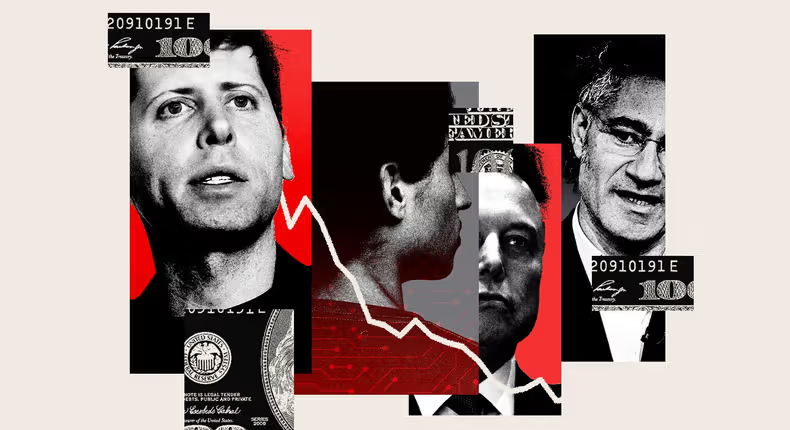
Sam Altman and Alex Karp are learning to hate one of Elon Musk's most frequent enemies
For years, Elon Musk waged a lonely war against short sellers. Now, as activists target nuclear SPACs and data giants, Sam Altman and Alex Karp are being drafted into the same fight.
New York— In the rarefied air of the tech oligarchy, there is a rite of passage more painful than a down-round and more personal than a Congressional hearing. You haven't truly arrived until someone bets their career that you are a fraud.
For Elon Musk, that moment stretched over a decade of "funding secured" tweets and parking lot espionage, culminating in the incineration of billions of dollars of short positions held by titans like Jim Chanos and David Einhorn. Now, the torch has passed. The new vanguard of Silicon Valley—OpenAI’s Sam Altman and Palantir’s Alex Karp—is finding itself locked in the same existential trench warfare against the market’s professional pessimists.
The enemy is the activist short seller. And for the first time, the "visionaries" are realizing that their greatest threat isn't AI safety or government regulation. It is a PDF report from a hedge fund in Midtown Manhattan.
The Attack on the "Story Stock"
The latest salvo was fired not at an AI model, but at a nuclear reactor.
Oklo Inc., the advanced fission startup chaired by Sam Altman, went public via SPAC in a maneuver that valued the zero-revenue company at over $1.5 billion. It was the quintessential "story stock"—selling a vision of unlimited, clean energy for the AI age.
Then came the report.
Kerrisdale Capital, a notorious short-selling firm with a history of targeting overhyped tech, released a blistering analysis of Oklo. They didn't attack the nuclear physics; they attacked the math. Calling the company "basically a PowerPoint," Kerrisdale highlighted a jarring statistic: Oklo has no revenue, no approved design, and likely won't generate significant power until the 2030s.
"It is a meme stock," the report concluded.
The stock plummeted. For Altman, who has largely operated in the private markets where valuations are drafted by friendly venture capitalists, this was a cold shower of public market reality. In the private world, you sell the future. In the public world, you have to survive the quarter.
The Palantir "Middle Finger"
If Altman is currently taking fire, Alex Karp is standing on the ramparts returning it.
For years, Palantir Technologies was the favorite target of short sellers who viewed it as a glorified consulting firm masquerading as a SaaS platform. They pointed to its reliance on government contracts and its stock-based compensation (SBC) which diluted shareholders.
Karp, Palantir’s eccentric, cross-country skiing CEO, didn't issue polished press releases. He went on the offensive.
"If you don't like our company, don't buy it," Karp famously told CNBC, suggesting that short-term investors should "buy bonds" instead.
But 2024 changed the calculus. Palantir turned a profit. It was added to the S&P 500. The stock ripped upward, forcing short sellers to cover their positions at a massive loss—a classic "short squeeze" reminiscent of Tesla's 2020 ascent.
"I love burning the short sellers," Karp admitted recently, echoing the exact sentiment Musk has tweeted dozens of times. The validation wasn't just financial; it was philosophical. Karp proved that a company could violate Wall Street’s norms (high SBC, weird governance) and still win if the product was indispensable.
The Physics of the Short
Why does this matter? Because the "Short Seller" is the natural predator of the "Visionary."
The conflict is structural.
- The Visionary (Musk, Altman, Karp) operates on a timeline of decades. They are selling a paradigm shift (Mars colonization, AGI, Western dominance). To them, current financial metrics are irrelevant distractions.
- The Short Seller (Kerrisdale, Hindenburg, Citron) operates on a timeline of months. They look at Price-to-Earnings ratios, cash burn, and audit footnotes. To them, a promise without profit is a lie.
In the zero-interest-rate phenomenon (ZIRP) era of 2010-2021, the Visionaries won by default. Money was free, and investors were happy to wait. But as interest rates hover near 5%, the cost of capital has returned. The Short Seller has regained their teeth.
This is why Altman’s encounter with Kerrisdale is a bellwether. It signals that the "AI Premium" is not bulletproof. Just because Sam Altman touches a company doesn't mean it gets a pass on fundamental gravity.
The Contrarian Take: The Necessary Evil
While Musk, Karp, and Altman paint short sellers as value-destroying parasites, the uncomfortable truth is that the market needs them.
Short sellers are the immune system of capitalism.
Consider the alternative: Wirecard. Enron. Nikola. In each of these cases, it wasn't the SEC or the auditors who uncovered the fraud. It was short sellers. They are the only financial actors incentivized to do the dirty work of investigating corporate malfeasance.
If short sellers didn't exist, the "hype cycle" driven by AI figures would spiral into a bubble of catastrophic proportions. By attacking Oklo, Kerrisdale is effectively asking the $1.5 billion question: Is this real?
If Altman is right, the stock will recover, and the shorts will lose money. The short seller acts as a stress test. If the company breaks under the pressure of a PDF report, it probably wasn't built to survive the nuclear regulatory environment anyway.
The Second-Order Effect: The "Anti-Public" Movement
The intensity of these attacks is having a profound secondary effect: It is driving innovation back into the shadows.
Observing the public floggings of Musk and now Altman, the next generation of founders is staying private longer. Why deal with Kerrisdale Capital dissecting your margin structure when you can raise $10 billion from Microsoft or BlackRock in a private room with no disclosure requirements?
This creates a two-tier market:
- The Private Elites: Where the true high-risk, high-reward innovation happens (SpaceX, OpenAI, Stripe), inaccessible to retail investors.
- The Public Leftovers: Companies that are "safe" enough for the public markets but lack the explosive potential of the private giants.
By declaring war on volatility and "story stocks," short sellers may be inadvertently protecting retail investors from risk, while simultaneously locking them out of the biggest wealth-creation events of the century.
The Final Verdict
Elon Musk eventually defeated the shorts, not by tweeting, but by selling millions of cars.
For Sam Altman and Alex Karp, the path is identical. You cannot sue a short seller into silence (though companies try), and you cannot out-debate them on CNBC. You have to out-execute them.
Alex Karp has largely crossed the Rubicon; Palantir’s cash flow is the ultimate shield. Sam Altman, however, is still in the danger zone with his periphery bets like Oklo. The "Sam Altman Premium" is currently facing its first real audit.
In the end, the short seller is simply the market’s way of asking: "Are you serious?"
Musk answered yes. Karp answered yes. Now, Altman must show his work.
Stay informed
Get our latest articles delivered to your inbox.
Related Articles
britannica review
Is britannica worth visiting today? From addictive daily word games to verified historical deep-dives, read our full review of the modern encyclopedia.
The Honeymoon is Over: Threads Just Turned on the Money Printer
Did you really think Mark Zuckerberg was running a charity? Of course not.
Samsung’s Android XR Glasses 2026: 12MP Camera, Dual Models, and the Fight for Your Face
Samsung is finally entering the smart glasses arena in 2026. New leaks reveal the upcoming Android XR glasses will feature a 12MP camera, deep Gemini AI integration, and a dual-model strategy to rival Meta’s Ray-Bans. Here is everything we know about the specs, the "Pro" variant, and why this could be the ultimate Android accessory.
[modo.us] Review: Is It Actually Useful or Just Hype?
Is Modo.us the best new social casino or just another coin trap? We spent two weeks testing the "Live Dealer" tables and grinding daily bonuses to see if the payouts are real—and if the $100 cash-out limit is a dealbreaker for casual players.