The "Silent" Crisis Driving Gold to $4,500 and Silver to $80
Gold and silver prices have gone vertical in 2025, but the primary driver isn't just inflation or tariffs. Discover why a historic breakdown in leadership at the Federal Reserve has sparked a "confidence crisis" that is sending precious metals to record highs.
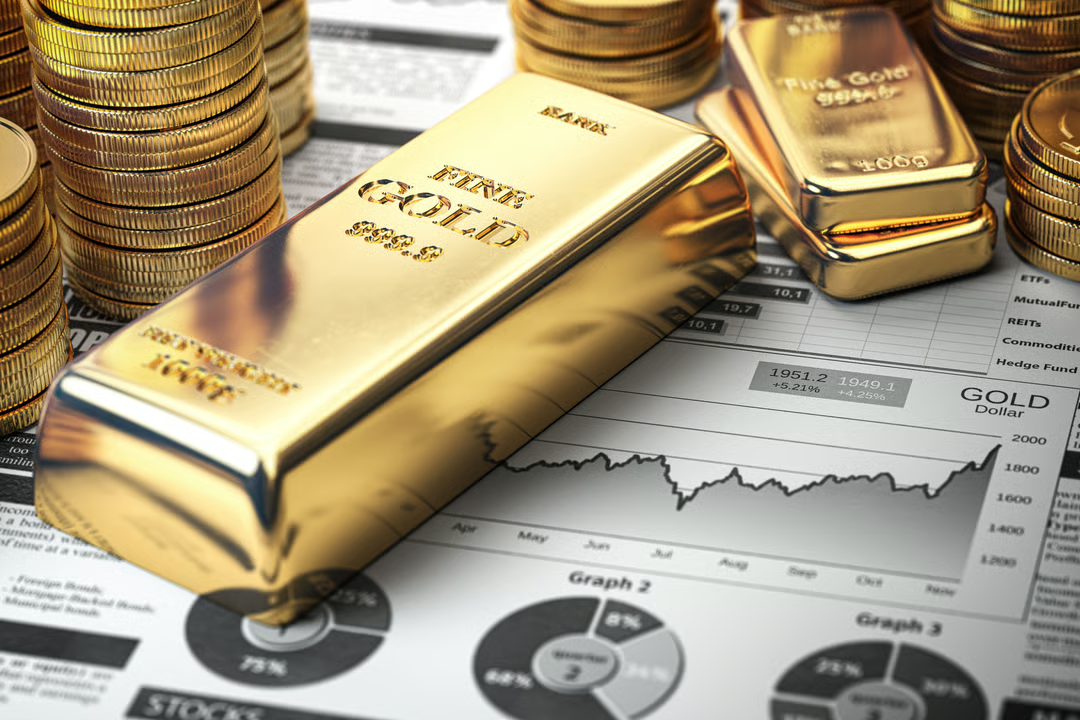
While the headlines have been dominated by AI stocks and tech sector volatility, a historic shift has occurred in the background. Gold has shattered expectations, climbing 74% this year to hit an all-time high of $4,562 per ounce. Silver has performed even more aggressively, posting a staggering 175% year-to-date gain, knocking on the door of $80 per ounce.
For months, investors have pointed to the "usual suspects" to explain this rally: rising global tariffs, ballooning U.S. debt, and the expansion of the M2 money supply.
But these factors, while important, are just the kindling. The actual spark—the primary catalyst that has sent these metals into a parabolic vertical climb—is something far more concerning, and it’s happening behind the closed doors of America’s most powerful financial institution.
The Foundation: Inflation and Tariffs (The "Known" Catalysts)
To understand the current explosion in prices, we first have to acknowledge the economic backdrop of 2025. It has been a year defined by uncertainty.
- The Return of Trade Wars: President Trump’s institution of a 10% global tariff rate (and higher reciprocal tariffs) in April cast a massive shadow over global commerce, driving investors toward safe-haven assets.
- Monetary Expansion: The U.S. M2 money supply has continued to expand rapidly. As basic economics dictates, when the supply of dollars increases faster than the output of goods, the purchasing power of that dollar falls. Gold and silver, being finite resources, have naturally re-priced higher in these cheaper dollars.
However, these factors have been present for much of the year. They explain a steady uptrend, but they don't explain the violent, parabolic move we've seen in the last two months.
The Real Catalyst: The Federal Reserve Has Lost Its Consensus
The true driver of this historic rally is a breakdown in leadership at the Federal Reserve.
For decades, the Fed has been a stabilizing force for Wall Street. Whether you agreed with their policy or not, the message was usually unified. The 12-member Federal Open Market Committee (FOMC) typically moved in lockstep, providing the market with clarity and certainty.
That certainty is gone.
According to recent meeting minutes, the Fed is no longer speaking with one voice. We are witnessing a historic level of dissent that signals deep internal confusion about how to handle the U.S. economy.
The "Opposite Dissent" Signal
In the last two FOMC meetings of 2025, the committee voted to lower rates by 25 basis points. But for the first time in modern history, we saw dissents in opposite directions at the same meeting:
- The Hawk: At least one member voted against any cut, arguing inflation is still too high.
- The Dove: At least one member argued the cut wasn't enough, pushing for a larger 50-basis-point reduction.
This type of "opposite dissent" is incredibly rare—occurring only three times in the last 35 years. Two of those times happened since late October 2025.
Why Investors Hate a Fractured Fed
Markets hate bad news, but they hate uncertainty even more.
When the Fed is unified, investors can hedge their bets. They know the "rules of the game." But a fractured Fed suggests that the central bank has lost the plot. It signals that the data is so conflicting—rising unemployment paired with sticky inflation (stagflation)—that the experts can no longer agree on a solution.
If the Fed doesn't know what to do, the "Fed Put" (the belief that the central bank will step in to save the market) effectively vanishes.
This loss of confidence has triggered a massive flight to safety. Investors aren't just buying gold to hedge against inflation; they are buying it to hedge against monetary chaos.
Expert Perspective: The "Confidence Crisis" Trade
The unique angle here is that we are witnessing a psychological shift, not just a financial one.
Historically, gold rallies when the dollar is weak. But this time, gold is rallying because institutional credibility is weak.
When the Fed Chair (whose term ends in May 2026) cannot corral his own committee, it suggests that the tools used to manage the economy are failing. The parabolic move in silver—often called "gold on steroids"—confirms that this is a broad-based exit from fiat-denominated trust.
The Bottom Line: The market is pricing in a scenario where the Fed loses control. If the central bank cannot agree on interest rates, they cannot effectively combat a recession or inflation. In that vacuum of authority, gold and silver become the only adults in the room.
Conclusion
The 2025 precious metals rally is about more than just supply and demand. It is a vote of no confidence in the current monetary regime. With gold near $4,600 and silver approaching $80, the market is screaming that the era of predictable central banking is over.
As we head into 2026 with an undecided Fed Chair replacement and a fractured committee, volatility is likely here to stay.
Stay informed
Get our latest articles delivered to your inbox.
Related Articles
Inside Elon Musk’s $134 Billion Invoice to OpenAI
Elon Musk has escalated his legal war against OpenAI, filing a demand for $134 billion in "wrongful gains" from the AI giant and its backer, Microsoft.
Trump Threatens Tariffs on Nations That Resist His Greenland Push
Trump threatened tariffs on countries that resist U.S. demands over Greenland, signaling a shift from trade policy to geopolitical coercion. Allies in Denmark and Congress push back, warning that economic pressure could fracture NATO and reshape Arctic strategy.
UK Marketing Budgets Flat in Q4 2025: IPA Bellwether Report
The numbers didn’t just slow down. They stopped.
Stop Overpaying Your Accountant: The Strategic Case for Algorithmic Tax Filing
Stop paying the "vanity accountant" tax. We analyze why smart investors are switching to H&R Block Deluxe for the 2026 tax season—and how a limited-time $30 deal makes the ROI undeniable.