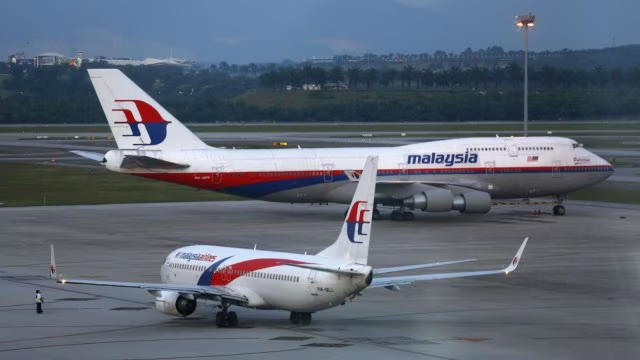
The $70 Million Gamble: Why the Hunt for MH370 Has Resumed After 11 Years
After 11 years of silence, the search for MH370 has resumed with a high-stakes $70 million "no cure, no fee" deal. Here is why experts believe this new, targeted mission in the Indian Ocean finally holds the key to solving aviation's greatest mystery.
Eleven years, nine months, and twenty-two days after Malaysia Airlines Flight MH370 vanished into the night, the engines of search vessels are humming once again in the southern Indian Ocean.
For the families of the 239 souls on board, December 30, 2025, wasn't just another Tuesday—it marked the potential end of an agonizing decade of silence. In a bold move that blends high-stakes finance with cutting-edge marine robotics, the Malaysian government has officially greenlit a new search operation. But this isn't just a repeat of past failures; the terms of engagement have changed.
The new mission is lean, data-driven, and financially risk-free for the Malaysian public—unless the plane is found. Here is why this latest attempt might finally solve modern aviation's greatest mystery.
The "No Cure, No Fee" Deal
The most striking aspect of this renewed search is the contract structure. Ocean Infinity, the Texas-based marine robotics firm leading the charge, has agreed to a "no find, no fee" proposal.
This creates a powerful incentive structure:
- The Risk: Ocean Infinity bears 100% of the operational costs. If they come back empty-handed, they lose millions in deployment expenses.
- The Reward: The Malaysian government will pay a reported $70 million USD only if the wreckage or flight data recorders are successfully located and identified.
This model, approved by the Malaysian Cabinet earlier this year, protects taxpayers who already funded the initial $150 million multinational search that ended in 2017. It also signals a massive vote of confidence from Ocean Infinity—companies generally do not bet eight-figure sums unless their data suggests a high probability of success.
Why Now? The Science of the "New Zone"
If previous searches covering 120,000 square kilometers failed, what makes this 55-day mission different? The answer lies in precision over scale.
Instead of casting a wide net, this mission targets a specific, high-probability zone of approximately 15,000 square kilometers (5,800 sq mi). This refined search area is the result of years of "back-office" analysis conducted while the ships were docked.
The "Seventh Arc" Refined
Experts have combined three critical data points to narrow the haystack:
- Drift Analysis: By modeling the movement of confirmed debris (like the flaperon found on Réunion Island), oceanographers have reverse-engineered the likely impact site with greater accuracy.
- WSPR Signals: Amateur radio researchers have proposed new tracking methods using Weak Signal Propagation Reporter (WSPR) data, which tracks disturbances in radio waves that may have been caused by the aircraft crossing specific paths.
- Satellite Handshakes: Re-examination of the final Inmarsat "handshakes" has tightened the radius along the famous "Seventh Arc" of the Indian Ocean.
Tech vs. The Deep: The Armada
Ocean Infinity isn't using traditional sonar towed slowly behind a ship. They are deploying a fleet of Autonomous Underwater Vehicles (AUVs). These "Hugin" drones operate untethered, diving up to 6,000 meters deep to scan the seabed with high-resolution synthetic aperture sonar.
This allows the team to scan vast areas much faster than previous expeditions. The 55-day operational window is relatively short, but with multiple drones in the water simultaneously, the data throughput is exponential.
The Human Cost: A Decade of Waiting
While the technology is fascinating, the core of this story remains the families who have been stuck in a tragic limbo since March 8, 2014.
For people like Danica Weeks and the members of the "Voice 370" association, the resumption brings a complex mix of relief and anxiety. "We've never stopped wishing for answers," Weeks noted in response to the news. The resumption validates their years of lobbying: the world has not moved on, even if the news cycle did.
The previous search ended in 2018 without a trace. This time, the Malaysian Ministry of Transport has emphasized that this is likely the "final major push" unless fresh evidence emerges, raising the emotional stakes to an all-time high.
Expert Perspective: The Corporate Confidence Signal
From a strategic standpoint, the most telling indicator here isn't the government's approval—it's Ocean Infinity's willingness to return.
The Bottom Line: In 2018, Ocean Infinity searched 112,000 sq km and failed. For them to return seven years later to a much smaller area suggests they possess new, proprietary intelligence or a breakthrough in data interpretation that they believe solves the puzzle.
Corporations are risk-averse. When a company bets its own balance sheet on finding a needle in a haystack, it usually means they have found a way to magnetize the needle. This isn't a "search" in the traditional sense; it is a targeted extraction mission based on a specific hypothesis.
Conclusion
The mystery of MH370 has haunted the aviation industry for over a decade. It exposed gaps in global tracking, changed how aircraft are monitored, and left a hole in the lives of hundreds of families.
As the ships reach the search zone this week, we are witnessing a pivotal moment. We will likely know within two months if the mystery is finally solved or if the Indian Ocean will keep its secret forever.
Stay informed
Get our latest articles delivered to your inbox.
Related Articles
Inside Elon Musk’s $134 Billion Invoice to OpenAI
Elon Musk has escalated his legal war against OpenAI, filing a demand for $134 billion in "wrongful gains" from the AI giant and its backer, Microsoft.
Trump Threatens Tariffs on Nations That Resist His Greenland Push
Trump threatened tariffs on countries that resist U.S. demands over Greenland, signaling a shift from trade policy to geopolitical coercion. Allies in Denmark and Congress push back, warning that economic pressure could fracture NATO and reshape Arctic strategy.
UK Marketing Budgets Flat in Q4 2025: IPA Bellwether Report
The numbers didn’t just slow down. They stopped.
Stop Overpaying Your Accountant: The Strategic Case for Algorithmic Tax Filing
Stop paying the "vanity accountant" tax. We analyze why smart investors are switching to H&R Block Deluxe for the 2026 tax season—and how a limited-time $30 deal makes the ROI undeniable.