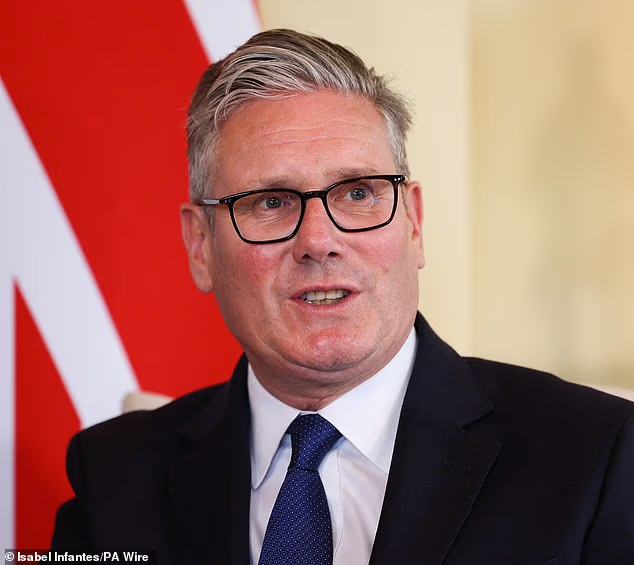
Starmer’s Diplomatic Tightrope: UK "Not Involved" in Shock Maduro Capture as PM Seeks Urgent Talks with Trump
Prime Minister Keir Starmer has officially distanced the UK from the dramatic US operation to capture Venezuelan President Nicolás Maduro. Here is why Downing Street is claiming "no involvement" and why Starmer is urgently seeking a call with President Trump.
The geopolitical chessboard was upended this morning with news that Venezuelan President Nicolás Maduro is in US custody, facing a litany of narco-terrorism and weapons charges in New York.
But while Washington celebrates what it calls a victory for justice, the mood in Downing Street is far more cautious. Prime Minister Keir Starmer has moved swiftly to distance the United Kingdom from the operation, explicitly stating that British forces were "not involved" in the dramatic capture that reportedly involved US airstrikes.
As the dust settles on one of the most audacious foreign interventions in modern history, Starmer is left navigating a precarious diplomatic path—one that leads directly to a phone call with President Donald Trump.
Here is what we know about the operation, the indictment, and the widening rift across the Atlantic.
The Denial: "We Were Not Involved"
Speaking from Downing Street, Keir Starmer’s message was brief, blunt, and designed to prevent blowback.
"The United Kingdom was not involved in the operation to detain Nicolás Maduro," Starmer told reporters, responding to rumors that RAF logistics might have supported the US mission.
Why the distancing? The operation, characterized by what sources are calling "surgical US airstrikes" in Caracas, technically constitutes a violation of Venezuelan sovereignty—an act of war. While the UK has long condemned the Maduro regime, Starmer is wary of endorsing unilateral military action that bypasses the United Nations. By clarifying the UK’s non-involvement, Starmer is attempting to:
- Protect British Interests: Avoid retaliation against UK assets in South America.
- Uphold International Law: Maintain the UK's stance on sovereign integrity, even regarding hostile regimes.
- Pacify the Left: Avoid a revolt within his own Labour party, which is historically skeptical of US-led regime change.
The Indictment: Drugs, Weapons, and a Supermax Cell
While the politics play out in London, the legal hammer has dropped in New York.
According to the unsealed indictment, Maduro is facing severe charges in the Southern District of New York (SDNY). The charges, which echo the US Department of Justice’s 2020 findings, paint the Venezuelan leader not as a president, but as the head of the "Cartel of the Suns."
The Charges at a Glance:
- Narco-Terrorism Conspiracy: Accusations of flooding the US with cocaine to undermine American society.
- Weapons Trafficking: The use of military-grade weaponry to protect illicit drug shipments.
- Corruption: Billions in embezzled state funds.
The image of a sitting head of state being extracted and flown to New York for trial is unprecedented since Manuel Noriega in 1989. It sends a chilling message to US adversaries, but it also creates a legal minefield that the UK is desperate to avoid stepping on.
The Trump Factor: Why Starmer Needs the Call
Perhaps the most telling part of Starmer’s reaction was his immediate pivot to the US executive branch. The Prime Minister confirmed he "wants to speak to President Trump" urgently.
The Context: With the timeline placing us in January 2026, the political dynamics are volatile. Whether this operation was a final act of the outgoing administration or a prelude to Trump's foreign policy doctrine, Starmer knows the rules of engagement have changed.
Starmer’s need to speak with Trump suggests:
- Alignment Checks: The UK needs to know if this "interventionist" approach is the new norm for the White House.
- Trade Implications: Stability in Latin America is crucial for global oil prices. A destabilized Venezuela could send crude prices soaring, impacting the UK economy.
- The "Special Relationship": If the US acted without consulting its closest ally, the "Special Relationship" might be more one-sided than London cares to admit.
The Bottom Line: The End of "Polite" Diplomacy?
Expert Perspective: Keir Starmer is in a lose-lose position. If he supports the capture, he endorses regime change by force. If he condemns it, he alienates the US administration right when he needs post-Brexit trade assurances.
The capture of Maduro signals a return to "Wild West" geopolitics. For decades, international norms protected heads of state. That protection has effectively been revoked.
Starmer’s claim of "non-involvement" is a necessary shield, but it is thin. The reality is that the UK’s silence will be interpreted as complicity by Maduro’s allies (Russia, Iran, China) and as weakness by the US hawks. The upcoming call with Trump will not just be a congratulatory chat; it will be a stress test for the Atlantic alliance in a world where the US is no longer asking for permission.
Conclusion: A New Era of Intervention?
As Maduro sits in a New York holding cell, the world waits to see the fallout. Will this trigger a wave of retaliation in South America? And can Keir Starmer maintain his neutral stance while the US rewrites the rulebook?
One thing is certain: The "Special Relationship" is about to get a lot more complicated.
Stay informed
Get our latest articles delivered to your inbox.
Related Articles
Artemis II Explained: Why NASA’s Next Moon Mission Won't Touch the Lunar Surface
Discover why NASA is choosing a flyby over a landing and how this high-stakes test drive paves the way for a permanent lunar presence.
Audio’s Red Carpet Moment: The Golden Globes Finally Bend the Knee to Podcasting
The Golden Globes have finally added a podcast category, signaling a massive shift in Hollywood's hierarchy. Here is why this isn't just about trophies—it's about the industry's obsession with audio IP as the new gold rush.
The Caliphate Ghost: Why the US Just Dropped 40 Tons of Ordnance on a "Defeated" Enemy
The US military's latest airstrikes in Syria aren't just about neutralizing ISIS remnants—they expose a fragile containment strategy teetering on the edge of failure. Here is why Washington is still dropping bombs on a "defeated" enemy seven years later.
The Man Who Skated Through the Apocalypse: Why T.K. Carter Mattered
T.K. Carter, best known as the boombox-toting Nauls in John Carpenter’s sci-fi classic The Thing, has died at 69. A career chameleon who moved effortlessly between sitcom warmth and gritty drama, Carter defied the "expendable" tropes of 80s horror to leave an indelible mark on Hollywood history.