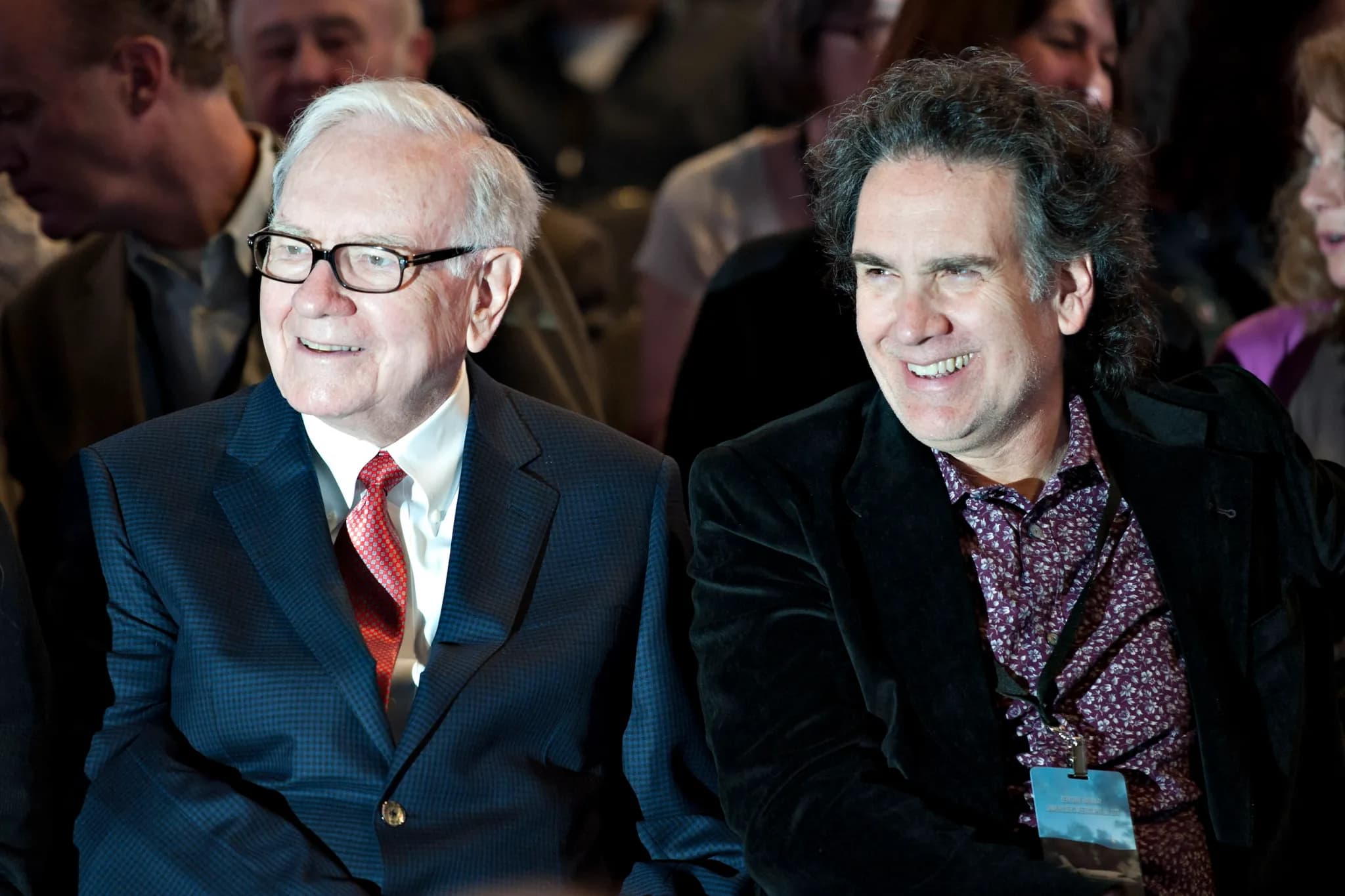
Warren Buffett’s son says he didn’t know his dad was a billionaire until he was in his 20s—and his friends were just as surprised
Why Warren Buffett’s Son Had to Read a Magazine to Learn He Was Rich
It is a scene that belongs in a Wes Anderson movie, not the biography of a financial titan. The year was around 1983. Peter Buffett, aged 25, was thumbing through a magazine likely Forbes or Fortune, when he saw a list that stopped him cold.
There, printed in black and white, was his father’s name. Warren Buffett. Net worth: staggering.
"We laughed about it," Peter told reporters recently, reflecting on the absurdity of the moment. "Because we said, 'Well, isn't it funny? You know, we know who we are, but everybody's treating us differently now.'"
For a quarter of a century, Warren Buffett had pulled off the ultimate behavioral arbitrage: he had accrued top-tier global capital while maintaining bottom-tier domestic overhead.
Peter wasn't just "unaware" of the specific number in his father’s bank account; he was oblivious to the very categorization of his family’s existence.
But the most telling data point isn't Peter’s ignorance. It is the community’s.
"I don't think people knew," Peter noted. "I think my friends were just as surprised as I was."
In an era of hyper-signaling—where wealth is usually broadcast before it is even liquid—the idea that a billionaire could hide his status from his son’s social circle suggests a level of discipline that exceeds stock picking. It raises the uncomfortable question for modern high-net-worth individuals: If your children know they are rich, have you already failed?
Engineering Normality
How does one hide an elephant in a living room?
Most billionaires isolate themselves in gated communities, inadvertently creating an echo chamber where "rich" is the baseline. Warren Buffett did the opposite. He stayed put.
The architecture of this deception was built on three structural pillars that defied the excesses of the 1980s corporate raider era:
- The Geographic Anchor: Warren bought his Omaha home in 1958 for $31,500. He never moved. He never built the sprawling compound. By remaining in a middle-class zip code, he ensured Peter’s "comps" his peer group—were not the children of other tycoons, but the children of dentists and teachers.
- The Public Utility: The Buffett children did not take limousines to private academies. They walked to the same public school (Rose Hill Elementary) as the rest of the neighborhood. They took the bus.
- The Domestic CEO: For decades, there was no staff. No entourage. Warren operated Berkshire Hathaway without a fleet of assistants.
This wasn't merely frugality; it was information control. By removing the signals of wealth, Warren removed the expectations of wealth.
Peter grew up thinking his father was merely a "security analyst." The term was technically accurate but woefully insufficient like calling the Pope a "religious administrator." Because the daily inputs of Peter's life (chores, allowance, public transit) didn't match the output of a billionaire lifestyle, the cognitive dissonance never formed. He simply assumed they were normal.
The $90,000 "Trust Fund"
The true test of this upbringing came when Peter turned 19. He received an inheritance—not from Warren’s empire, but from the sale of his grandfather’s farm. The total sum was roughly $90,000.
Converted to today’s dollars, that is significant, but it is hardly "retirement money." It was, in Warren’s calculus, "enough to do anything, but not enough to do nothing."
Peter’s next move proved the efficacy of his father’s information blackout. A trust-fund kid aware of the family safety net might have blown the cash on a sports car or a condo. Peter, unaware of the billions compounding in his father’s portfolio, treated that $90,000 as his only shot.
He sold the Berkshire Hathaway stock (which had been converted from the farm proceeds) to buy "time." He dropped out of Stanford to become a musician, using the cash to fund a frugal existence while he honed his craft.
"I didn't know how to do anything else," Peter said. "I didn't want to be in the financial world."
Had he held that stock, it would be worth over $300 million today. Financial Twitter loves to dunk on this "mistake." They miss the point. Peter bought a career, an identity, and eventually, an Emmy Award. He bought the ability to look in the mirror and see Peter Buffett, not "Warren Buffett’s son."
The Contrarian Take: The Privilege of Ignorance
While the narrative of the "oblivious normal kid" is charming, we must scrutinize the mechanics of this ignorance.
Is it truly possible to be "normal" when your father is Warren Buffett, even if you don't know the bank balance?
The "Safety Net" Paradox: Critics argue that even without the knowledge of wealth, Peter benefited from the reality of it. He could drop out of Stanford and move to San Francisco to play piano because, subconsciously or not, he knew he wasn't going to starve. The absence of existential economic dread is a luxury that $90,000 can’t buy, but a stable family structure can.
Furthermore, the "friends were surprised" angle reveals a limitation in social mobility. Peter’s friends were surprised because they, too, were likely from the stable middle-to-upper-middle class of Omaha. They weren't looking for signals of extreme wealth because their baseline was comfort. If Peter had been raising himself in actual poverty, the difference between his father’s "security analyst" job and a laborer's wage would have been stark.
The deception worked because the gap between "comfortable" and "billionaire" is invisible in daily life. Both drive cars, both eat dinner, both watch TV. The difference only appears in the extremes—the private jets, the islands, the political lobbying. By cutting off the extremes, Warren made the billions invisible.
The Death of the "Buffett Model"
We are unlikely to see this happen again.
In 2026, the internet has destroyed the possibility of the "Omaha Deception." A modern Peter Buffett would know his father’s net worth by age 10 via a Google search or a classmate’s TikTok comment. The transparency of data makes the "ignorance strategy" obsolete.
Today’s ultra-high-net-worth parents cannot hide the money. They must instead contextualize it.
This shifts the burden from secrecy to stewardship. Since you cannot pretend to be middle class, you must teach the responsibilities of the upper class without breeding the entitlement of the leisure class.
Warren Buffett’s parenting win wasn't that he hid the money; it’s that he filled the void where the money would have been with values. When Peter finally saw that magazine list, it was too late for the money to ruin him. He was already a guy who took the bus, wrote music, and knew the value of a dollar.
Stay informed
Get our latest articles delivered to your inbox.
Related Articles
Elon Musk Predicts Retirement Will Vanish in 20 Years—Here’s Why
"Saving for retirement will be irrelevant," Musk declared.
The Big Chill: US Job Openings Hit Lowest Level in Over a Year
US job openings have plunged to 7.1 million, the lowest level in over a year, shifting the labor market into a "low-hire, low-fire" stagnation. Discover what the latest JOLTS report reveals about the end of the Great Resignation and why employers now hold the leverage in a 0.91 ratio economy.
The 1% Club: Why Bank of America’s 200,000 Applicants Are Terrified of the Future
Bank of America CEO Brian Moynihan revealed a shocking statistic: 200,000 applicants fought for just 2,000 jobs, resulting in a 1% acceptance rate. Learn why the "lucky" few who made the cut are still terrified about their future and what this "flight to safety" means for the economy.
Oil Markets Crash to 2020 Lows: Why the Geopolitical "Fear Factor" is Gone (And What It Means for Russia)
Oil prices are on track for their worst annual performance since 2020, with WTI dropping to $58. Discover why the "geopolitical fear premium" has vanished and how a 50% revenue plunge is crushing Russia's war economy.