Artemis II Explained: Why NASA’s Next Moon Mission Won't Touch the Lunar Surface
Discover why NASA is choosing a flyby over a landing and how this high-stakes test drive paves the way for a permanent lunar presence.
The images will be historic. For the first time in over 50 years, humans will look out a porthole and see the Moon not as a distant glowing disc, but as a cratered, imposing world filling their field of view.
But as the Artemis II crew swings around the lunar far side, capturing photos that will define a generation, they will do something that might confuse the casual observer: they will keep going.
They won’t descend. They won’t land. They won’t leave footprints.
For space enthusiasts and the tax-paying public alike, this can feel like a teasing half-step. If we have the rocket (the SLS) and the capsule (Orion), why not just land? The answer isn't about capability; it's about a fundamental shift in how we approach space exploration.
We aren't racing a rival superpower this time; we are racing against the physics of sustainability.
This deep dive explains exactly why Artemis II is designed as a flyby, what critical systems are on the line, and why this "test drive" is the most dangerous and necessary hurdle before we can truly return to stay.
The Mission Profile: A 10-Day Road Test
To understand why they aren't landing, you have to understand what Artemis II actually is. It is not a colonization mission. It is a shakedown cruise.
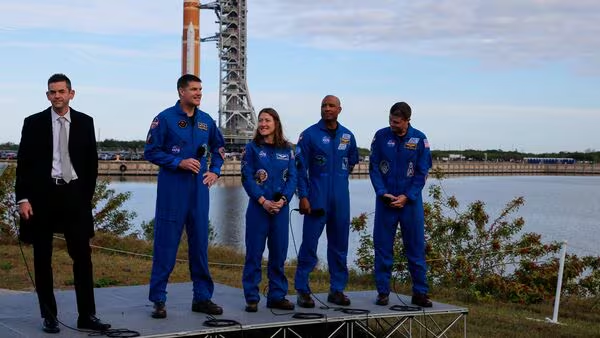
Scheduled for late 2025 (or possibly 2026), the mission will send four astronauts—Reid Wiseman, Victor Glover, Christina Koch, and Jeremy Hansen—on a trajectory that takes them further into space than any human has traveled since the Apollo program.
The flight path is known as a hybrid free-return trajectory. After launching from Florida, the spacecraft will orbit Earth twice to build up speed and check systems. Then, a trans-lunar injection burn will shoot them toward the Moon. They will loop around the Moon, using its gravity to slingshot them back toward Earth.
The entire journey will take approximately 10 days. During this time, the crew isn't just sitting there; they are actively stress-testing the Orion Spacecraft, the vessel that will serve as the hunter-gatherer of data for all future lunar landings.
The Critical "Why": Life Support in Deep Space
The primary reason Artemis II won't land is simpler than rocket science: breathing.
Artemis I, which successfully launched in late 2022, was an unqualified success. It proved the Space Launch System (SLS) rocket could fly and that the Orion capsule could survive re-entry at Mach 32. But there was one thing Artemis I didn't have: lungs.
Artemis I was uncrewed. It did not need to scrub CO2, generate oxygen, regulate humidity, or manage waste for living organisms. Artemis II is the first time the Environmental Control and Life Support System (ECLSS) will be tested with actual humans in the loop.
- The Deep Space Difference: Testing life support on the International Space Station (ISS) is one thing; testing it 230,000 miles away is another. On the ISS, if a system fails, you can be home in hours. In deep space, a return trip takes days.
- The Human Heat Load: Humans are essentially 100-watt heaters that exhale moisture. NASA needs to verify that Orion's radiators and humidity controls can handle four people living in a tight can for over a week without the atmosphere becoming toxic or the walls dripping with condensation.
If NASA attempted a landing on this first crewed flight, they would be introducing the chaotic variables of descent and ascent while still trying to verify if the basic "keep humans alive" systems work reliably. That is a risk matrix no engineer would sign off on.
Navigating the Radiation Gauntlet
Another major objective that precludes a landing is the study of radiation shielding.
The journey will take the crew through the Van Allen Radiation Belts—zones of energetic charged particles captured by Earth's magnetic field. While Apollo astronauts passed through these quickly, modern safety standards are far stricter.
Artemis II is gathering critical data on how effectively Orion shields the crew from this radiation. A landing mission would expose the crew to the surface radiation environment of the Moon as well, compounding the variables.
By keeping this mission strictly orbital (or rather, a trans-lunar loop), NASA isolates the variables of deep-space transit radiation.
This data is vital not just for the moon, but for the eventual Mars missions, where radiation exposure will be the single greatest threat to crew health.
The Rendezvous and Proximity Operations (RPO) Demo
While they won't land on the moon, the crew will practice "landing" something else: the spacecraft itself.
Shortly after reaching orbit, the crew will separate Orion from the Interim Cryogenic Propulsion Stage (ICPS)—the upper stage of the rocket that pushes them toward the moon. Once separated, they will turn Orion around and perform a series of delicate maneuvers to get close to the ICPS target.
Why does this matter?
- Manual Control: This tests the crew's ability to manually pilot the spacecraft in case automated systems fail.
- Docking Simulation: This mimics the maneuvers required for Artemis III and IV, where Orion will have to dock with the Starship HLS (Human Landing System) or the Gateway lunar space station.
If the crew cannot flawlessly execute these proximity maneuvers in open space, they certainly cannot be trusted to dock with a lander in lunar orbit. This "practice run" is a mandatory gate that must be passed before a landing attempt can be authorized.
The Hardware Gap: We Don't Have a Lander Yet
There is also a practical, logistical reason for not landing: The lander isn't ready.
Unlike the Apollo missions, where the Command Module and Lunar Module launched together, the Artemis architecture relies on a rendezvous in lunar orbit. The astronauts launch in Orion, fly to the moon, and then transfer to a separate lander (SpaceX's Starship HLS) to go down to the surface.
As of early 2026, the Starship HLS is still in aggressive development and testing. It requires orbital refueling tests and uncrewed lunar landing demos before humans can step aboard.
Even if Orion were ready to support a landing today, there is no "taxi" waiting at the moon to take them down to the surface. Artemis II bridges the gap, validating the transport vehicle (Orion) while the destination vehicle (Starship) finishes development.
Expert Perspective: The "Go Fever" Antidote
Here is the analytical takeaway that most mainstream coverage misses: Artemis II is an apology for the Space Shuttle.
In the history of spaceflight, "Go Fever"—the rush to meet schedules over safety—has been fatal. It contributed to the Apollo 1 fire and the Challenger and Columbia disasters. The Artemis program is deliberately designed to be slow, methodical, and redundant.
By splitting the "return to the moon" into two distinct missions—Artemis II (crew transit check) and Artemis III (landing check)—NASA is decoupling the risks.
- Risk Decoupling: If the life support on Orion fails during Artemis II, the crew can abort back to Earth on a free-return trajectory without having to worry about being stuck on the lunar surface.
- System Maturity: This approach allows the ground teams to mature the mission control procedures for deep space human spaceflight, something that hasn't been done since 1972. The muscle memory of Mission Control has to be rebuilt just as much as the hardware.
The decision not to land is actually a sign of the program's maturity. It signals that NASA is prioritizing the sustainability of the program over the "flags and footprints" PR win. They aren't trying to prove they can get there; they are trying to prove they can stay there.
The Bottom Line
Artemis II will carry astronauts to the moon but not land because you don't take a car cross-country without checking the brakes first. This mission is the ultimate test drive. It is about verifying that humans can eat, sleep, breathe, and communicate in the hostility of deep space.
It is the final exam before graduation. And while the crew of Artemis II won't kick up lunar dust, they will pave the road for the woman and person of color who will walk on the south pole of the Moon in Artemis III.
Related Reading:
Stay informed
Get our latest articles delivered to your inbox.
Related Articles
Audio’s Red Carpet Moment: The Golden Globes Finally Bend the Knee to Podcasting
The Golden Globes have finally added a podcast category, signaling a massive shift in Hollywood's hierarchy. Here is why this isn't just about trophies—it's about the industry's obsession with audio IP as the new gold rush.
The Caliphate Ghost: Why the US Just Dropped 40 Tons of Ordnance on a "Defeated" Enemy
The US military's latest airstrikes in Syria aren't just about neutralizing ISIS remnants—they expose a fragile containment strategy teetering on the edge of failure. Here is why Washington is still dropping bombs on a "defeated" enemy seven years later.
The Man Who Skated Through the Apocalypse: Why T.K. Carter Mattered
T.K. Carter, best known as the boombox-toting Nauls in John Carpenter’s sci-fi classic The Thing, has died at 69. A career chameleon who moved effortlessly between sitcom warmth and gritty drama, Carter defied the "expendable" tropes of 80s horror to leave an indelible mark on Hollywood history.
‘Uninvestable’: Trump pitch to oil execs yields no promises
Despite the dramatic capture of Nicolás Maduro and a White House push for a $100 billion investment to flood the market with cheap crude, US oil titans like ExxonMobil are rejecting President Trump's Venezuela pitch. The verdict? Without massive legal and economic reforms, the world's largest oil reserves remain "uninvestable.”