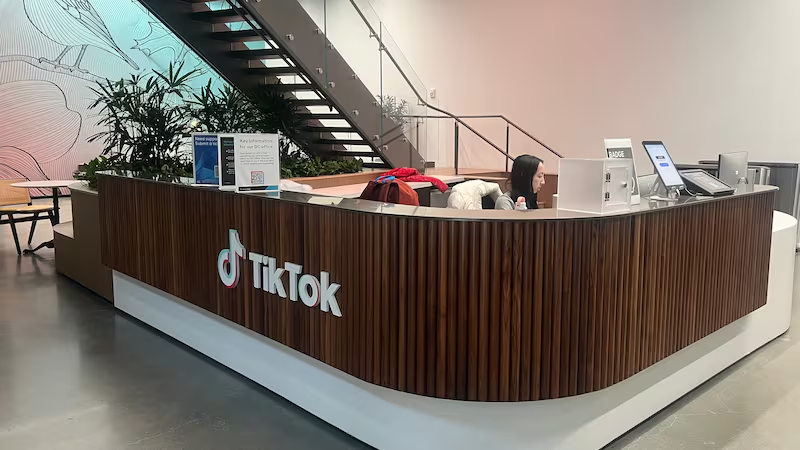
TikTok’s 11th-Hour Rescue: Why the Oracle, MGX, & Silver Lake Deal Changes Everything
The clock runs out on January 22. Inside the Oracle, MGX, and Silver Lake deal to save TikTok in the US, the risks of "Project Texas," and what the new ownership structure means for marketers and the algorithm.
The clock is ticking for TikTok in the United States. With the January 22, 2026, deadline rapidly approaching, the long-awaited resolution to the app's national security saga appears to be finalized. A powerhouse consortium led by Oracle, Silver Lake, and the UAE-based MGX is poised to take the reins of a new American-centric entity, tentatively titled "TikTok USDS Joint Venture LLC."
For business leaders, marketers, and the 170 million Americans who scroll daily, this isn't just a corporate reshuffle—it is the potential end of a digital cold war. But as the ink dries, critical questions remain: Will the algorithm survive the transition? And is this truly a clean break from ByteDance?
Here is everything you need to know about the deal that will define the digital landscape of 2026.
The Deal at a Glance: Anatomy of a Rescue
The structure of this acquisition is designed to thread a very specific needle: satisfying U.S. national security demands without destroying the app’s commercial viability.
Based on the latest reports from The National and recent filings, the ownership of the new U.S. entity breaks down as follows:
- The "American" Consortium (45%): Oracle, Silver Lake, and MGX will each hold a 15% stake. While MGX is an Emirati firm, its inclusion is strategic, bringing capital without triggering the same adversarial concerns as Chinese ownership.
- ByteDance (19.9%): The Chinese parent company retains a minority stake, stripping it of majority control.
- Existing Investors (35.1%): The remaining shares will be distributed among current international investors.
Key Takeaway: This structure theoretically pushes "friendly" ownership (US and UAE) to a controlling position, while Oracle takes on the critical role of "trusted technology partner," hosting user data on its U.S. cloud infrastructure.
Project Texas 2.0: The Security Firewall
The backbone of this deal is an initiative known as Project Texas. Originally proposed in 2023, it has now been operationalized as the standard for TikTok's U.S. survival.
- Data Localization: All U.S. user traffic is being routed to Oracle Cloud Infrastructure. This creates a physical and digital firewall, ensuring American data does not reside on servers accessible by Beijing.
- Code Audits: Oracle and third-party monitors are tasked with reviewing the source code. Their goal is to ensure there are no "backdoors" that could allow for data exfiltration or foreign influence campaigns.
- Algorithm Retraining: Perhaps the most controversial aspect is the requirement to "retrain" the recommendation algorithm within the U.S. environment. This is intended to ensure the "For You" page is free from external manipulation, but it poses a massive technical challenge.
The "Why" Behind the Buy
Why are titans like Larry Ellison (Oracle) and Egon Durban (Silver Lake) stepping in?
- Cloud Dominance: For Oracle, this is a massive contract. Hosting 170 million active users proves their cloud capabilities can rival AWS and Azure.
- Ad Revenue: Despite the drama, TikTok remains a cash cow. Analysts project U.S. ad revenue could top $17 billion in 2026.
- Geopolitical Leverage: MGX’s involvement highlights the growing role of the Middle East as a neutral broker and financier in U.S.-China tech decoupling.
Expert Perspective: The "Secret Sauce" Dilemma
The Bottom Line: While the corporate structure satisfies the lawyers, the product risk is higher than admitted.
The "magic" of TikTok has always been its algorithm—a black box of code optimized by ByteDance’s engineers in Beijing. By forcing the U.S. entity to control and potentially retrain this algorithm independently, there is a distinct possibility of performance degradation.
If the new U.S. algorithm becomes less addictive or less precise at predicting user interests, engagement could drop. Marketers should be wary of a "volatility period" in Q1 and Q2 of 2026 where reach and engagement metrics might fluctuate wildly as the new systems come online.
Furthermore, the geopolitical risk isn't zero. Beijing has previously hinted that it views the algorithm as a national export control. If the Chinese government decides to block the transfer of the underlying technology (even if they allow the sale of the asset), the U.S. consortium might be buying a car without an engine.
Conclusion: A New Era or a Slow Decline?
The January 22 closing date is a historic milestone, but it is not the finish line. The success of TikTok USDS will depend on execution: Can Oracle keep the app running smoothly? Will creators stay loyal if the algorithm hiccups?
Stay informed
Get our latest articles delivered to your inbox.
Related Articles
britannica review
Is britannica worth visiting today? From addictive daily word games to verified historical deep-dives, read our full review of the modern encyclopedia.
The Honeymoon is Over: Threads Just Turned on the Money Printer
Did you really think Mark Zuckerberg was running a charity? Of course not.
Samsung’s Android XR Glasses 2026: 12MP Camera, Dual Models, and the Fight for Your Face
Samsung is finally entering the smart glasses arena in 2026. New leaks reveal the upcoming Android XR glasses will feature a 12MP camera, deep Gemini AI integration, and a dual-model strategy to rival Meta’s Ray-Bans. Here is everything we know about the specs, the "Pro" variant, and why this could be the ultimate Android accessory.
[modo.us] Review: Is It Actually Useful or Just Hype?
Is Modo.us the best new social casino or just another coin trap? We spent two weeks testing the "Live Dealer" tables and grinding daily bonuses to see if the payouts are real—and if the $100 cash-out limit is a dealbreaker for casual players.